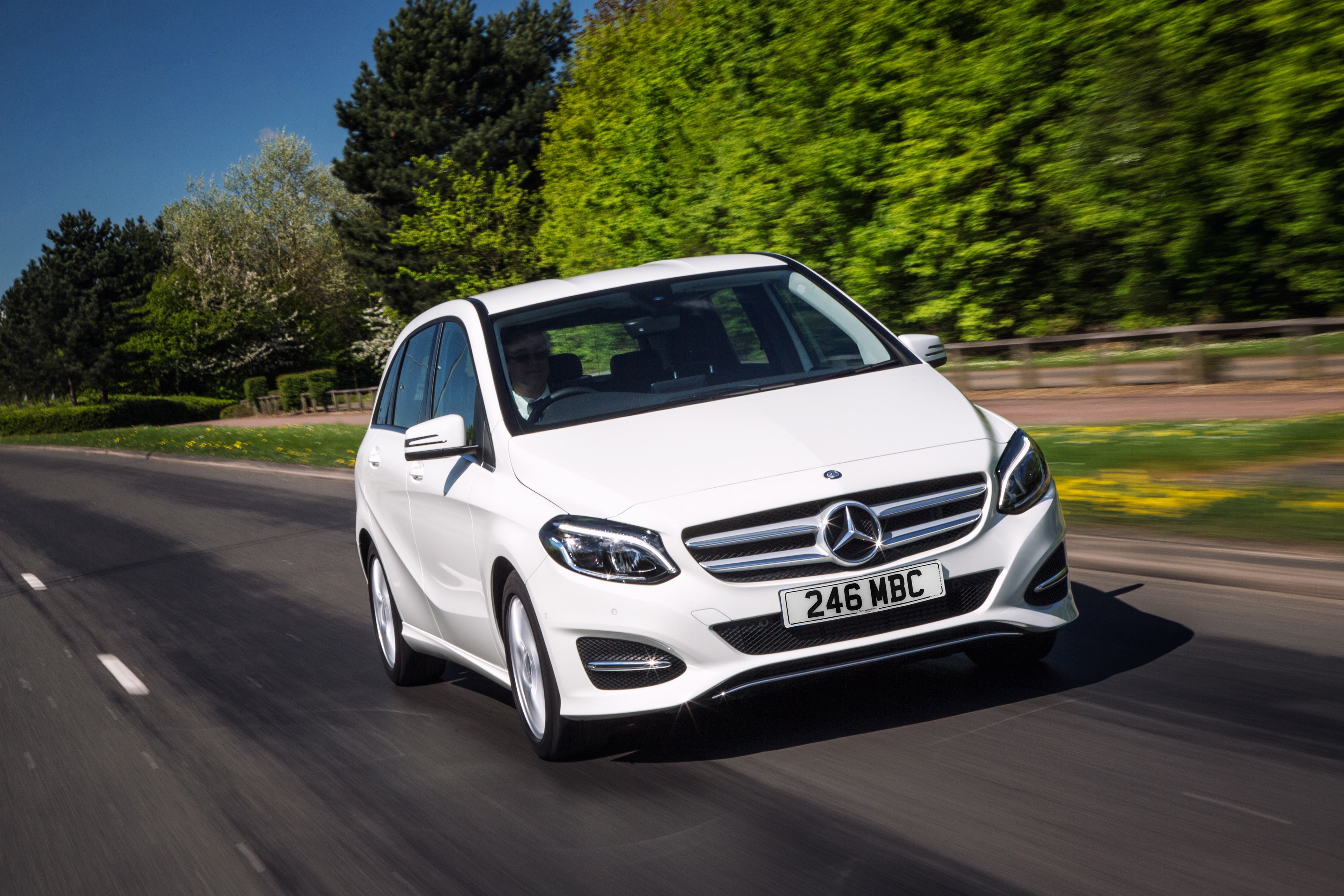
Just as you'd expect, the Mercedes-Benz C-Class Cabriolet follows the same design cues as the Coupé with one exception, the multi-layer electronically-operated acoustic soft-top that replaces the standard metal roof. It will fold up or down at speeds of up to 31 mph, and can be had in black, dark blue, dark red or dark brown.
But enough about that, what about the standard equipment? Mercedes will throw in a reversing camera, a Garmin sat nav, heated seats, Active Park Assist, LED headlights, DAB digital radio, and sports seats finished in mad-made Artico leather. That's what makes up entry-level Sport trim, which is finished off with 17-inch alloy wheels and keyless entry (the latter being available solely on automatic models). And if that's not enough, two convertible specialities are included too - Airscarf will keep your neck warm with heater vents built into the headrests, and Aircap will lessen the effects of the wind in your hair by diverting it over the windshield and above the cabin.
For £1,495, you can upgrade to AMG Line. This adds a black ash wood trim with brushed aluminium detailing, a sports flat-bottomed steering wheel, steel sports pedals, black roof lining, AMG bodystyling and 18-inch alloys. The C-Class Cabriolet finished in AMG Line gets a 15 mm lower suspension setup.
Premium Plus package (£1,695) is only available on automatic models, and adds blind spot monitoring, lane keep assistant, Distronic Plus, Pre-safe Plus and Pre-safe Brake with pedestrian detection for everyone's utmost safety.
Two petrols and two diesels are available. The C 200 and C 300 both make use of a 2.0-litre petrol engine, producing 184 and 245 horsepower. Claimed MPG figures are in the 40s, and both are available with the 9G-TRONIC 9-speed automatic transmission however the C 200 comes as standard with a 6-speed manual.
When it comes to diesel power, the C 220 d produces 170 horsepower. The 6-speed manual is reserved for rear-wheel-drive models, however the 9G-TRONIC is available on RWD and AWD. There's also a C 250 d with 204 horsepower and a 9G-TRONIC.
If you want something a bit quicker, Mercedes will sell you the AMG C 43 4MATIC. The 3.0-litre bi-turbo V6 produces 367 horsepower and gets to 62 mph in 4.8 seconds through the 9G-TRONIC gearbox. Standard kit for this sizzling soft-top includes 18-inch alloy wheels, an AMG performance exhaust, black mirrors housings, Artico and Dinamica upholstery and the words 'BITURBO 4MATIC' places on the front wings.
Of course, if this isn't fast enough for you, the C 63 will be what you're looking for. The 4.0-litre V8 produces 476 horsepower and 650 Nm, making it good for 0-62 mph in 4.2 seconds. Upgrade this to the C 63 S for an additional 34 horsepower and 50 Nm, shaving 0.1 s off the sprint time.
The Mercedes-AMG C 63 comes with Nappa leather upholstery, "V8 BITURBO" on the front wings and a spoiler lip. The C 63 S adds a Nappa and Dinamica sports steering wheel, 19-inch alloys, an electronic rear limited-slip differential and AMG performance seats which are an option on the C 63 (£1,405).
The boisterous cars cost £65,685 and £72,245, however if you've got £78,295 that you need to spend, put down your deposit on the C 63 S Edition 1 which features unique diamond-stitched Nappa upholstery in black and brown, matt carbon fibre interior trim and bespoke alloy wheels which measure 19 inches up front and 20 inches at the rear.
Don't worry, for £36,200 you can get the entry-level C 200 Sport, just over £4,500 more than the C-Class Coupé.
Categories
- Alfa Romeo (3)
- Audi (16)
- Bentley (1)
- BMW (14)
- Citroen (4)
- Dacia (2)
- DS (2)
- Fiat (3)
- Ford (4)
- Geneva2016 (15)
- Honda (4)
- Hyundai (6)
- Infiniti (2)
- Jaguar (1)
- Jeep (1)
- Kia (8)
- Land Rover (3)
- Lexus (3)
- Mazda (1)
- Mercedes-Benz (19)
- MINI (2)
- NewYork2016 (2)
- Other (12)
- Pagani (1)
- Peugeot (4)
- Renault (10)
- SEAT (5)
- Skoda (3)
- SsangYong (2)
- Subaru (1)
- Tesla (1)
- Top Gear (1)
- Toyota (4)
- Vauxhall (16)
- Volkswagen (14)
- Volvo (8)
Search This Blog
Showing posts with label Mercedes-Benz. Show all posts
Tuesday, 21 June 2016
Friday, 10 June 2016
Mercedes E-Class Estate Quickly Joins Saloon
The Mercedes E-Class Estate is now in its sixth generation, having had a complete redesign just a few days ago to fit in line with the all-new E-Class Saloon.
The main reason you would buy an estate over its saloon equivalent is, of course, the boot space. That's why the E-Class manages to squeeze in 670 litres of capacity into a well-shaped area, with the narrowest part, between the wheel arches, being 110 cm. Fold the seats down and you're faced with an 1820-litre cavern. As standard, Mercedes will give you 40:20:40 split folding rear seats - essentially each rear seat will fold down individually. Another standard feature is a clever system that allows you to make the rear seat backs roughly 10 degrees steeper, which frees up a further 30 litres of space in the boot whilst still allowing "full use" of the seats. Electronic switches in the boot make it easy to fold down the rear seats without having to walk around to the back doors.
EASY-PACK is what Mercedes calls its electronically powered tailgate, and guess what, it comes as standard. What doesn't come as standard is the KEYLESS-GO with HANDS-FREE ACCESS which allows you to open the boot with a kicking motion under the rear bumper. Your guess is as good as mine when it comes to why Mercedes capitalises its options and technology, though.
Being an estate, you're likely to be loading the boot up quite a bit. That's why a self-levelling rear air suspension is, yet again, standard kit. All-round AIR BODY CONTROL air suspension is, however, an option. The self-levelling rear air suspension can deal with up to 745 kg in the boot, depending on the model you choose, which is in the region of 10 people's weight. It can also deal with a trailer which can weigh up to 2,100 kg.
Inside, you can have your E-Class Estate similarly specced to the E-Class Saloon. The main feature is what appears to be one long high-res screen taking place of the instrument cluster and infotainment display. In fact, it consists of two 12.3-inch displays that sit behind one long sheet of glass. The driver can control what he or she sees with touch-sensitive controls on the steering wheel, the regular touchpad and controller in the centre console which recognises handwriting for the satellite navigation, and the LINGUATRONIC voice recognition.
Mercedes has taken all the steps it could to make the E-Class Estate "one of the quietest estate vehicles" in its class. This has included sealed door handles and door joints, extra sealing on the side windows, and wing mirrors and A-pillars that have been optimised aeroacoustically. If that's not enough, the Acoustic Comfort package can be specified at an additional cost from late 2016, and features an acoustic film in the windscreen and side windows as well as more insulation in the rear footwells and central tunnel.
Active Brake Assist will, in worst case scenarios, apply the brakes autonomously in order to help avoid any collision. DRIVE PILOT, an option, is as near to autonomous driving as we can get today. It's essentially an advanced cruise control that can work at speeds of up to 130 mph. Another cool bit of tech is the Remote Parking Pilot, which allows you to perform tight manoeuvres from outside the vehicle using nothing but your smartphone, similar to what we saw with the latest-generation BMW 7 Series.
So now that we've covered what makes the E-Class Estate different to the Saloon, let's take a quick look at the engines. Unfortunately, there's nothing new. All the Saloon's engines have just been carried over.
A brand-new 2.0-litre diesel engine is set to replace the noisier 2.1-litre unit. That will be found in the E 220 d which boasts a reasonable 191 bhp and 400 Nm. With CO2 emissions of just 109 g/km, the E 220 d will be very good to tax. MPG figures are a claimed 67.3, with a 0-62 mph sprint time of 7.7 seconds which is quick enough for most buyers.
Fancy yourself a more powerful diesel? Mercedes will be releasing the E 350 d in the last quarter of 2016. Its 3.0-litre V6 makes 254 bhp and 620 Nm. MPG figures are a bit lower, at 52.3, with CO2 emissions rising to 140 g/km. A provisional 0-62 mph time has been given to it of 6.2 seconds.
All models come as standard with the 7G-TRONIC 9-speed automatic transmission. Shift times are quicker for the AMG E 43 4MATIC, though. This uses a 3.0-litre V6 petrol engine to produce 396 bhp and 520 Nm. It will race to 62 mph in 4.7 seconds and emit a not-so-good 192 g/km. Mercedes claims a combined figure of 33.6 mpg.
Rivals such as the Volvo V90 and Audi A6 Avant offer similar engine choices, with two diesels and a plug-in petrol hybrid for the Volvo and two diesels and a 4.0-litre V8 petrol for the Audi. BMW currently offers the most, however this model has been going the longest and therefore has had time to see the introduction of more engines along its timeline. These include 5 diesels and 3 petrols.
The main reason you would buy an estate over its saloon equivalent is, of course, the boot space. That's why the E-Class manages to squeeze in 670 litres of capacity into a well-shaped area, with the narrowest part, between the wheel arches, being 110 cm. Fold the seats down and you're faced with an 1820-litre cavern. As standard, Mercedes will give you 40:20:40 split folding rear seats - essentially each rear seat will fold down individually. Another standard feature is a clever system that allows you to make the rear seat backs roughly 10 degrees steeper, which frees up a further 30 litres of space in the boot whilst still allowing "full use" of the seats. Electronic switches in the boot make it easy to fold down the rear seats without having to walk around to the back doors.
EASY-PACK is what Mercedes calls its electronically powered tailgate, and guess what, it comes as standard. What doesn't come as standard is the KEYLESS-GO with HANDS-FREE ACCESS which allows you to open the boot with a kicking motion under the rear bumper. Your guess is as good as mine when it comes to why Mercedes capitalises its options and technology, though.
Being an estate, you're likely to be loading the boot up quite a bit. That's why a self-levelling rear air suspension is, yet again, standard kit. All-round AIR BODY CONTROL air suspension is, however, an option. The self-levelling rear air suspension can deal with up to 745 kg in the boot, depending on the model you choose, which is in the region of 10 people's weight. It can also deal with a trailer which can weigh up to 2,100 kg.
Inside, you can have your E-Class Estate similarly specced to the E-Class Saloon. The main feature is what appears to be one long high-res screen taking place of the instrument cluster and infotainment display. In fact, it consists of two 12.3-inch displays that sit behind one long sheet of glass. The driver can control what he or she sees with touch-sensitive controls on the steering wheel, the regular touchpad and controller in the centre console which recognises handwriting for the satellite navigation, and the LINGUATRONIC voice recognition.
Mercedes has taken all the steps it could to make the E-Class Estate "one of the quietest estate vehicles" in its class. This has included sealed door handles and door joints, extra sealing on the side windows, and wing mirrors and A-pillars that have been optimised aeroacoustically. If that's not enough, the Acoustic Comfort package can be specified at an additional cost from late 2016, and features an acoustic film in the windscreen and side windows as well as more insulation in the rear footwells and central tunnel.
Active Brake Assist will, in worst case scenarios, apply the brakes autonomously in order to help avoid any collision. DRIVE PILOT, an option, is as near to autonomous driving as we can get today. It's essentially an advanced cruise control that can work at speeds of up to 130 mph. Another cool bit of tech is the Remote Parking Pilot, which allows you to perform tight manoeuvres from outside the vehicle using nothing but your smartphone, similar to what we saw with the latest-generation BMW 7 Series.
So now that we've covered what makes the E-Class Estate different to the Saloon, let's take a quick look at the engines. Unfortunately, there's nothing new. All the Saloon's engines have just been carried over.
A brand-new 2.0-litre diesel engine is set to replace the noisier 2.1-litre unit. That will be found in the E 220 d which boasts a reasonable 191 bhp and 400 Nm. With CO2 emissions of just 109 g/km, the E 220 d will be very good to tax. MPG figures are a claimed 67.3, with a 0-62 mph sprint time of 7.7 seconds which is quick enough for most buyers.
Fancy yourself a more powerful diesel? Mercedes will be releasing the E 350 d in the last quarter of 2016. Its 3.0-litre V6 makes 254 bhp and 620 Nm. MPG figures are a bit lower, at 52.3, with CO2 emissions rising to 140 g/km. A provisional 0-62 mph time has been given to it of 6.2 seconds.
All models come as standard with the 7G-TRONIC 9-speed automatic transmission. Shift times are quicker for the AMG E 43 4MATIC, though. This uses a 3.0-litre V6 petrol engine to produce 396 bhp and 520 Nm. It will race to 62 mph in 4.7 seconds and emit a not-so-good 192 g/km. Mercedes claims a combined figure of 33.6 mpg.
Rivals such as the Volvo V90 and Audi A6 Avant offer similar engine choices, with two diesels and a plug-in petrol hybrid for the Volvo and two diesels and a 4.0-litre V8 petrol for the Audi. BMW currently offers the most, however this model has been going the longest and therefore has had time to see the introduction of more engines along its timeline. These include 5 diesels and 3 petrols.
Thursday, 7 April 2016
Cabriolet Joins the Mercedes S-Class Family
If you would have said to a fan of Mercedes a few years back that the S-Class would be available in Coupé and Cabriolet forms as well as the Saloon, they would have laughed at you. But that's exactly where we are today, and we wouldn't at all be surprised if an Estate car comes along either!
But for now, the Cabriolet needs some explanation. The Saloon version comes with a diesel hybrid (S 300 h) and a petrol hybrid (S 400 h). There's also a petrol plug-in hybrid (S 500 e) and a standard diesel (S 350 d). It's the petrols that really impress, though, with an S 500 and S 600, as well as Mercedes-AMG S 63 and S 65. Despite Mercedes already having developed so many engines, it may come as a surprise to you that there are only three engines headed for the Cabriolet, and they are:
- S 500
- twin-turbocharged 4.6-litre V8
- 449 bhp
- 0-62 mph in 4.6 seconds
- 32.5 mpg, 204 g/km
- 9G-TRONIC automatic transmission
- £110,120
- S 63
- twin-turbocharged 5.5-litre V8
- 577 bhp
- 0-62 mph in 4.2 seconds
- 237 g/km
- AMG SPEEDSHIFT MCT 7-speed automatic transmission
- £135,675
- S 65
- twin-turbocharged 6.0-litre V12
- 621 bhp
- 0-62 mph in 4.1 seconds
- 272 g/km
- AMG SPEEDSHIFT PLUS 7G-TRONIC automatic transmission
- £192,805
All models are electronically limited to a top speed of 155 mph, however the AMG models can be released to 186 mph for £2,760 (S 63) or £765 (S 65) as part of the AMG Driver's package.
The 'entry-level' S 500 is far from entry level. It comes as standard in the highest AMG Line trim with 19-inch alloy wheels, LED headlights, AIRMATIC air suspension, dual 12.3-inch displays, AIRSCARF heating from the headrests, all-round heated seats, front ventilated seats and an automatic boot separator for the roof.
The S 63 gets design upgrades in line with the rest of Mercedes-AMG's cars as well as 'V8 BITURBO' lettering on the front wings and a 13-speaker Burmester surround sound system.
Similarly, the S 65 gets 'V12 BITURBO' lettering and an upgraded 23-speaker Burmester system. It also features 20-inch alloys and LED headlights with Swarovski crystals.
Wednesday, 23 March 2016
All-New Mercedes GLC Coupé Finally Enters Market and Fights off BMW's X4
At 1.6 metres high, the Mercedes GLC Coupé is slightly shorter than the BMW X4 and a fair bit shorter than the regular GLC. It's also 8 cm longer than the regular GLC despite sharing the same wheelbase, which helps give it the coupé-esque look Mercedes was aiming for.
The A-pillar is more gently raked, which when combined with the short overhangs and sharp spoiler lip similar to that of the S-Class Coupé, makes the GLC Coupé a very elegant car. Nevertheless, it's an SUV. We're reminded of that with the pronounced shoulders, prominent bumpers and bold grille.
Inside, the large console panel is a one-piece design with the intention of making the interior of the GLC Coupé a light and airy place to be. At one end, it fuses into the double-door centre storage compartment, while at the other end it's joined by a separate tablet-style infotainment display. Its 491-litre boot is in line with competition from BMW and Porsche, and can offer over 1,200 litres of space upon folding down the rear seats.
As standard, all GLC Coupés will get DYNAMIC SELECT with the usual five driver profiles (ECO, COMFORT, SPORT, SPORT+ and INDIVIDUAL). AIR BODY CONTROL is not part of the package and will come at an extra cost for the customer. It's an air suspension system that will adapt to the driver's needs, such as lowering by 15 mm in SPORT+ mode or dipping the rear end by 40 mm for ease of access into the boot.
With a Cd value of 0.31, it's significantly better than the BMW X4 (0.35), but weighing as little as 1,710 kg, the GLC Coupé isn't too dissimilar to the X4. The low weight figure is achieved thanks to the use of aluminium and high-strength steel. The 9G-TRONIC automatic transmission unit also weight 12 kg less than the previous generation.
Mercedes plans to offer four diesel engines and four petrol engines, the latter encompassing a hot AMG version and a plug-in hybrid. But from launch, we'll be more limited on choice.
The GLC 220 d 4MATIC and GLC 250 d 4MATIC use the same engine tuned to either 168 or 201 bhp. They're both capable of a claimed 55 mpg, emitting as little as 131 g/km. Those figures are impressive when considering both models are equipped with a heavy four-wheel-drive system.
At the moment, there's only a GLC 250 4MATIC when it comes to petrol power, which produces 208 bhp. It will be joined by a Mercedes-AMG 43 4MATIC which gets its 362 bhp from a bi-turbocharged V6 powerplant, making it good for 0-62 mph in less than 5 seconds.
Just like many other models offered by Mercedes, the GLC Coupé will also be home to a plug-in hybrid model. Called the GLC 350 e 4MATIC, it will emit as little as 59 g/km despite getting to 62 mph in 5.9 seconds and on to a top speed of 146 mph. With an output of 316 bhp, it fair outweighs the GLC 250 4MATIC. It can even travel some 20 miles on electric only.
Most models will be fitted as standard with 4MATIC all-wheel-drive, with all but the GLC 350 e 4MATIC Coupé using a 9-speed automatic transmission (9G-TRONIC). It's the 7-speed 7G-TRONIC that finds itself in the hybrid.
Standard equipment is extremely generous, with 18-inch alloy wheels, a reversing camera, keyless entry, fake leather and an electric tailgate. COLLISION PREVENTION ASSIST, ATTENTION ASSIST, Crosswind Assist and Headlamp Assist are also part of the extensive kit list.
An ENTRY 1 special edition will be available from launch with 20-inch AMG alloys, designo paint and two-tone leather upholstery.
The A-pillar is more gently raked, which when combined with the short overhangs and sharp spoiler lip similar to that of the S-Class Coupé, makes the GLC Coupé a very elegant car. Nevertheless, it's an SUV. We're reminded of that with the pronounced shoulders, prominent bumpers and bold grille.
Inside, the large console panel is a one-piece design with the intention of making the interior of the GLC Coupé a light and airy place to be. At one end, it fuses into the double-door centre storage compartment, while at the other end it's joined by a separate tablet-style infotainment display. Its 491-litre boot is in line with competition from BMW and Porsche, and can offer over 1,200 litres of space upon folding down the rear seats.
As standard, all GLC Coupés will get DYNAMIC SELECT with the usual five driver profiles (ECO, COMFORT, SPORT, SPORT+ and INDIVIDUAL). AIR BODY CONTROL is not part of the package and will come at an extra cost for the customer. It's an air suspension system that will adapt to the driver's needs, such as lowering by 15 mm in SPORT+ mode or dipping the rear end by 40 mm for ease of access into the boot.
With a Cd value of 0.31, it's significantly better than the BMW X4 (0.35), but weighing as little as 1,710 kg, the GLC Coupé isn't too dissimilar to the X4. The low weight figure is achieved thanks to the use of aluminium and high-strength steel. The 9G-TRONIC automatic transmission unit also weight 12 kg less than the previous generation.
Mercedes plans to offer four diesel engines and four petrol engines, the latter encompassing a hot AMG version and a plug-in hybrid. But from launch, we'll be more limited on choice.
The GLC 220 d 4MATIC and GLC 250 d 4MATIC use the same engine tuned to either 168 or 201 bhp. They're both capable of a claimed 55 mpg, emitting as little as 131 g/km. Those figures are impressive when considering both models are equipped with a heavy four-wheel-drive system.
At the moment, there's only a GLC 250 4MATIC when it comes to petrol power, which produces 208 bhp. It will be joined by a Mercedes-AMG 43 4MATIC which gets its 362 bhp from a bi-turbocharged V6 powerplant, making it good for 0-62 mph in less than 5 seconds.
Just like many other models offered by Mercedes, the GLC Coupé will also be home to a plug-in hybrid model. Called the GLC 350 e 4MATIC, it will emit as little as 59 g/km despite getting to 62 mph in 5.9 seconds and on to a top speed of 146 mph. With an output of 316 bhp, it fair outweighs the GLC 250 4MATIC. It can even travel some 20 miles on electric only.
Most models will be fitted as standard with 4MATIC all-wheel-drive, with all but the GLC 350 e 4MATIC Coupé using a 9-speed automatic transmission (9G-TRONIC). It's the 7-speed 7G-TRONIC that finds itself in the hybrid.
Standard equipment is extremely generous, with 18-inch alloy wheels, a reversing camera, keyless entry, fake leather and an electric tailgate. COLLISION PREVENTION ASSIST, ATTENTION ASSIST, Crosswind Assist and Headlamp Assist are also part of the extensive kit list.
An ENTRY 1 special edition will be available from launch with 20-inch AMG alloys, designo paint and two-tone leather upholstery.
Thursday, 17 March 2016
Mercedes CLA Gets a Facelift
Mercedes claims that since they've started selling more compact models (of which there are a total of 5: A-Class, B-Class, CLA, CLA Shooting Brake and GLA), the customer base has become younger. This can only mean one thing. The Germans need to step away from the old man's wood and start thinking about what younger customers are looking for.
The facelift paves Mercedes' way for doing just that. New bumpers at the front and subtle changes at the rear make it look just that little bit more sleek, while a black diamond grille oozes quality.
Outside, a new Cavansite blue metallic paint is available alongside five 18-inch alloy wheels. Step inside and some new seat covers and trim parts broaden the options list. Chrome-plated controls such as those of the door-mounted electrically adjustable seats remind the occupants that they're sitting in what is essentially a premium compact vehicle.
All CLA models are equipped as standard with active brake assist, but the options list goes a long way. Some of its assets are LED headlights that have been tweaked to closely resemble natural daylight as opposed to bright xenon. Talking about xenon headlights, the new LED technology, according to Mercedes, uses 60% less energy, and up to 70% less energy than standard halogen headlights.
Elsewhere, you can find the tickbox for Apple CarPlay and Android Auto, as well as keyless entry which now includes hands-free access to the boot via a waving motion by the foot under the rear bumper.
One thing you won't be short on is engine choices. There are no less than 11 engines with two- or four-wheel drive as options.
Kicking off the diesels is the CLA 180 d BlueEFFICIENCY. Power comes from a 1.5-litre engine, with figures of over 80 mpg and as low as 89 g/km. Despite that, the 108 bhp and 260 Nm make it good for 0-62 mph in 11.6 seconds.
There's also a regular CLA 180 d which isn't quite as efficient. Two 2.1-litre diesel engines produce 134 and 175 bhp and 300 and 350 Nm. They're the CLA 200 d and CLA 220 d, both of which are optionally available with 4MATIC four-wheel-drive. Running costs are around the 70 mpg mark, with emissions below 110 g/km. You can't go wrong.
The extensive petrol lineup starts with another economy-orientated model, the CLA 180 BlueEFFICIENCY. This time, a 1.6-litre engine produces 120 bhp and 200 Nm. This means around 50 mpg and 117-126 g/km of CO2.
Another bog-standard CLA 180 is available as well as a more powerful 154 bhp 250 Nm CLA 200. It's the CLA 220 4MATIC that really impresses. Mercedes has channelled 181 bhp and 300 Nm through all four wheels, whilst still retaining mpg figures in the 40s and around 150 g/km. That's from a 2.0-litre unit, just like the CLA 250 and CLA 250 Sport, both of which can be specified with 4MATIC. They produce 208 and 215 bhp and 350 Nm, yet can still achieve figures not too far from those of the CLA 220 4MATIC.
Lastly is the Mercedes-AMG CLA 45 4MATIC which boasts all the same figures as the AMG A 45 4MATIC hot hatch. They are 376 bhp, 475 Nm, around 40 mpg, 162 g/km of CO2, and more crucially, 0-62 mph in 4.2 seconds. That's all from a modest 2.0-litre 4-cylinder petrol engine.
The facelift paves Mercedes' way for doing just that. New bumpers at the front and subtle changes at the rear make it look just that little bit more sleek, while a black diamond grille oozes quality.
Outside, a new Cavansite blue metallic paint is available alongside five 18-inch alloy wheels. Step inside and some new seat covers and trim parts broaden the options list. Chrome-plated controls such as those of the door-mounted electrically adjustable seats remind the occupants that they're sitting in what is essentially a premium compact vehicle.
All CLA models are equipped as standard with active brake assist, but the options list goes a long way. Some of its assets are LED headlights that have been tweaked to closely resemble natural daylight as opposed to bright xenon. Talking about xenon headlights, the new LED technology, according to Mercedes, uses 60% less energy, and up to 70% less energy than standard halogen headlights.
Elsewhere, you can find the tickbox for Apple CarPlay and Android Auto, as well as keyless entry which now includes hands-free access to the boot via a waving motion by the foot under the rear bumper.
One thing you won't be short on is engine choices. There are no less than 11 engines with two- or four-wheel drive as options.
Kicking off the diesels is the CLA 180 d BlueEFFICIENCY. Power comes from a 1.5-litre engine, with figures of over 80 mpg and as low as 89 g/km. Despite that, the 108 bhp and 260 Nm make it good for 0-62 mph in 11.6 seconds.
There's also a regular CLA 180 d which isn't quite as efficient. Two 2.1-litre diesel engines produce 134 and 175 bhp and 300 and 350 Nm. They're the CLA 200 d and CLA 220 d, both of which are optionally available with 4MATIC four-wheel-drive. Running costs are around the 70 mpg mark, with emissions below 110 g/km. You can't go wrong.
The extensive petrol lineup starts with another economy-orientated model, the CLA 180 BlueEFFICIENCY. This time, a 1.6-litre engine produces 120 bhp and 200 Nm. This means around 50 mpg and 117-126 g/km of CO2.
Another bog-standard CLA 180 is available as well as a more powerful 154 bhp 250 Nm CLA 200. It's the CLA 220 4MATIC that really impresses. Mercedes has channelled 181 bhp and 300 Nm through all four wheels, whilst still retaining mpg figures in the 40s and around 150 g/km. That's from a 2.0-litre unit, just like the CLA 250 and CLA 250 Sport, both of which can be specified with 4MATIC. They produce 208 and 215 bhp and 350 Nm, yet can still achieve figures not too far from those of the CLA 220 4MATIC.
Lastly is the Mercedes-AMG CLA 45 4MATIC which boasts all the same figures as the AMG A 45 4MATIC hot hatch. They are 376 bhp, 475 Nm, around 40 mpg, 162 g/km of CO2, and more crucially, 0-62 mph in 4.2 seconds. That's all from a modest 2.0-litre 4-cylinder petrol engine.
Monday, 15 February 2016
Mercedes Paves the Way with an All-New 2.0-Litre Diesel Engine
Mercedes is paving the way for the future of diesel engines with a brand-new 2.0-litre 4-cylinder unit that is, as Mercedes claims, “future-proof”. The new RDE (Real Driving Emissions) legislation that’s due to arrive in Europe between 2017-2020 will emphasise a car’s real-world running figures, as opposed to the unachievable ones that we see all too often today.
THE OM 654, therefore, provides the basis for a whole new family of engines that will see an improvement in fuel consumption and emissions. Some of the things that make this new engine so effective include an all-aluminium build, steel pistons, NANOSLIDE® cylinder coating to minimise friction losses and of course weight reduction. The new 2.0-litre engine tips the scales at 168.4 kg - 34.4 kg less than the old 2.1-litre unit.
It will be put to use first in the all-new high-tech E-Class Saloon that’s due in Spring. It’s the E 220d that will be lucky enough to gain such an asset. It pairs the efficient engine with a slick 9-speed torque converter automatic ‘box. Figures come out at 72.4 mpg and 102 g/km which places the premium car into the £20/year tax bracket.
Of course, the Germans do not hold back in flaunting some figures that show its best side, such as the improvement that two decades has brought. Back in 1995, Mercedes’ passenger car average numbers were 30.7 mpg and 230 g/km of CO2. Today mpg has almost doubled to 56.5 and CO2 emissions nearly halved to 125 g/km.
But is the OM 654 as “future-proof” as they hope? Ja, or nein? Ja if you buy it now, but buy it after the 1st of April 2017 and it’s a big fat nein. It will end up costing £140 every single year to tax, that’s an increase of 600%! No doubt it will be cheaper than the old 2.1-litre diesel would be, but it doesn’t bear great news for the buyer.
THE OM 654, therefore, provides the basis for a whole new family of engines that will see an improvement in fuel consumption and emissions. Some of the things that make this new engine so effective include an all-aluminium build, steel pistons, NANOSLIDE® cylinder coating to minimise friction losses and of course weight reduction. The new 2.0-litre engine tips the scales at 168.4 kg - 34.4 kg less than the old 2.1-litre unit.
It will be put to use first in the all-new high-tech E-Class Saloon that’s due in Spring. It’s the E 220d that will be lucky enough to gain such an asset. It pairs the efficient engine with a slick 9-speed torque converter automatic ‘box. Figures come out at 72.4 mpg and 102 g/km which places the premium car into the £20/year tax bracket.
Of course, the Germans do not hold back in flaunting some figures that show its best side, such as the improvement that two decades has brought. Back in 1995, Mercedes’ passenger car average numbers were 30.7 mpg and 230 g/km of CO2. Today mpg has almost doubled to 56.5 and CO2 emissions nearly halved to 125 g/km.
But is the OM 654 as “future-proof” as they hope? Ja, or nein? Ja if you buy it now, but buy it after the 1st of April 2017 and it’s a big fat nein. It will end up costing £140 every single year to tax, that’s an increase of 600%! No doubt it will be cheaper than the old 2.1-litre diesel would be, but it doesn’t bear great news for the buyer.
Tuesday, 26 January 2016
Mercedes SLC
The SLC is simply a refreshed SLK under Mercedes' new nomenclature. As a result, the engines have remained unchanged.
The SLK 200d is now the SLC 200d. It's still a 2.1-litre 201 bhp 500 Nm diesel that averages a claimed 70.6 mpg and 114 g/km. It'll still get to 62 mph in 6.6s.
The story's the same for the petrols. Both are 2.0-litre units producing 181 and 242 bhp respectively. Their impressive 300 and 370 Nm figures help them get to 62 mph in 6.9 and 5.8s too. Mercedes likes to think that they'll both get 47 mpg, but in my experience, my personal car that has the same claimed figure actually averages 35 mpg.
The only engine that has changed is the 5.5-litre V8 of the Mercedes-AMG SLK 55. In the name of none other than efficiency, a new 3.0-litre biturbo V6 is utilised. It produces 53 bhp and 20 Nm less, but only takes 0.1s more to reach 62 mph (now 4.7s). CO2 emissions have dropped too, now costing £225 a year to tax as opposed to £265. It's dubbed the Mercedes-AMG SLC 45, has an electronically-limited top speed of 155 mph and costs £8,995 less than the outgoing model. You can hardly grunt at that!

- SLC 45
Some standard kit that we'll see on the new SLC includes Active Brake Assist, Attention Assist and an Active Bonnet that helps provide more of a 'crumple zone'. Headlamp Assist also shows its face, aiding with the refreshed halogen headlights. LED technology is used for the daytime running lights and tail lights.

All cars get alloy wheels, with the range kicking off with 17-inch 5-spoke wheels.
Some optional kit includes LED headlights with Adaptive Highbeam Assist Plus for £1,150. Keyless Go is also available for £765, which incorporates an automatic boot separator, a handy life-facilitating feature.

Its main rivals are the German alternatives, the Audi TT Roadster and BMW Z4. Audi offers the same setup of two petrols, a diesel and a hot petrol, whereas BMW has a range of no less than 5 petrols with a range-topping Z4 sDrive35iS.
These both start cheaper than Mercedes, but Mercedes' standard kit and engine outputs put even the entry-level SLC in line with some mid-spec competition.
There's also cheaper rivals to look out for like the new Mazda MX-5, or equally the Porsche Boxster which is somewhat more expensive. Saying that, its entry-level 2.7-litre V6 is capable enough to beat the SLC 300 and costs £168 more.
Monday, 25 January 2016
Mercedes C-Class Estate
Introduction
The all-new C-Class Estate followed the redesign of the hugely popular C-Class Saloon. Not only are they used by many a family across the country, but they're also favoured by company car drivers as a comfortable motorway mile muncher.
The refreshed Estate's wheelbase grew by 8cm, whilst outside, it's 9.6cm longer and 4cm wider. This all results in an increase in space inside, particularly for rear occupants. The boot size remained almost unchanged, which is no bad thing. There's 490 litres on offer in most C-Class Estates (the C 300h and C 350e get 450 and 350 litres respectively. The majority of buyers will enjoy 1,510 litres of space upon folding down the 40:20:40 split folding rear seats which come as standard right across the range (an upgrade over the previous generation's 60:40 setup).

Powertrains
Mercedes has a range of 4-cylinder engines on offer for the new C-Class Estate, as well as some nippy AMGs and sensible hybrids.
If you remain unconvinced and prefer petrol power, you haven't got much thinking to do. Your only option is the C 200. It's a 2.0-litre unit that produces a more-than-adequate 181 bhp and 300 Nm. This makes it good for 0-62 mph in 7.5 seconds putting it up against the Audi A4 Avant 2.0 TFSI and BMW 320i Touring, all of which costing between £28,400 and £28,900. Running costs of 51.4 mpg and £110 road tax don't make it a particularly enticing option when you take a look at the diesels.
The entry-level 1.6-litre C 200d produces a measly 134 bhp and 300 Nm. It's the most economical diesel too, at just over 65 mpg. That doesn't quite match rivals such as BMW's EfficientDynamics and Audi's ultra. It'll cost a tenner to tax.
There are also two 2.1-litre diesel units. The C 220d and C 250d. They produce 168 and 201 bhp respectively, as well as 400 and 500 Nm of torque. The quickest of all conventionally-powered C-Class Estates is the C 250d, reaching 62 mph in 6.9s. They're both said to do over 60 mpg, costing £10 and £20 to tax.

Although Mercedes doesn't have a four-wheel-drive 4MATIC on offer, therefore falls a pace behind the vast array of rivals (BMW 320i xDrive, 320d xDrive, 330 xDrive, 335d xDrive, Audi A4 2.0 TFSI quattro, 2.0 TDI quattro and 3.0 V6 TDI quattro), it does offer one unique prospect that the others don't. Or should I say two prospects.
The C 300h uses the 2.1-litre diesel engine as well as an additional boost provided by electricity. This means almost 230 bhp and 500 Nm, and a 0-62 mph time of 6.4s. It'll even get more than 70 mpg, and it's completely free to tax!
If it's a plug-in hybrid you're after, then look no further than the C 350e. It uses a 2.0-litre petrol engine, electricity and batteries to make 275 bhp and 600 Nm. It's half a second quicker to 62 mph than the C 300h, and produces half the CO2 (49 g/km). They say it'll do up to 134.5 mpg, too. Both hybrids cost north of £38,000.
There are even two hyper-C-Classes. The Mercedes-AMG C63 and C63 S utilise 4.0-litre V8 petrol engines to produce 469 and 503 bhp. With a hefty 650 and 700 Nm of torque, they're able to get to 62 mph in 4.2 and 4.1s. They both average just over 30 mpg and cost £265 to tax, emitting 196 g/km.
Standard Kit
All C-Class Estates get alloy wheels, a reversing camera, automatic wipers, a 7-inch infotainment display and an automatic powered tailgate, dubbed EASY-PACK.
Entry-level SE gets comfort suspension with 5 driving modes, a tyre pressure monitoring system, black ARTICO leather upholstery, LED daytime running lights and halogen headlights (although Audi's entry-level A4 Avant gets xenon headlights).

Active Parking Assist, upgraded alloys, LED headlights, Garmin® navigation, heated front sports seats and 15mm lower suspension are all part of the Sport trim, although it's worth noting that the C 350e Sport gets air suspension instead.
AMG Line brings along with it uprated brakes, steering and suspension as well as AMG bodystyling, sports seats and steering wheel. The 18-inch alloys are particularly charming.
Options
The cheapest package is the Executive package. It's a tad under £1,300 and is only available on entry-level SE models. It brings many of the Sport trim's features at a reduced cost.
Then you have the Premium package for almost £1,700. It has ambient lighting, keyless entry and a memory function for the front seats, steering wheel and exterior mirrors. The Premium Plus package costs nearly £3,000 and adds a 13-speaker Burmester® surround sound system and an upgraded 8.4-inch display with added functionality. This is available for Sport and AMG Line.

For £895 you can get Mercedes' highly regarded AIRMATIC self-levelling variable air suspension on Sport and AMG Line C-Class Estates.
The 360-degree camera system is a steal at £335, it's available on all by SE trims. Same goes for the panoramic glass sunroof (£900). For £825 on these trims, you can get a head-up display, but privacy glass is available across the whole range for £265.
My C-Class Estate
This is how I would order my C-Class Estate on a moderate budget:
Tuesday, 13 October 2015
Mercedes B-Class
Introduction
If you’re in the market for a 5-seat MPV, you’re spoiled for choice. But narrow that search down to premium brands and you only have 2 options. The brand new BMW 2 Series Active Tourer or today’s car for discussion, the Mercedes-Benz B-Class.
Introduced back in mid-2005, the B-Class was essentially the first premium MPV and at the time looked like a big A-Class and a small R-Class before they all parted ways. In late 2011 the 2nd generation B-Class was released bearing a complete redesign. Late last year the 2nd generation B-Class received its first major facelift which brought new bumpers, additional chrome detailing and, for the first time, integrated DRLs (daytime running lights). Optional equipment like keyless go, full LED headlights and the option for a larger infotainment display were also added. The pricetag was refreshed too, costing just under £22,000.
Powertrain
If you still favour petrol power you have 2 options, both utilising a 1.6-litre unit. The B200 is what stands out the most with adequate acceleration and running costs not too dissimilar from the B180. Saying that, with 34 less horsepower and 50 less Newton metres of torque, the B180 doesn’t ask to be driven as heavy-footedly and therefore is more likely to obtain an mpg figure closer to what Mercedes claims.
Step over to diesel and you’ll be greeted with the entry-level 1.5-litre B180d. It’s the least powerful in the whole line-up with only 109 horsepower, but is said to achieve 70.6 mpg however a figure closer to 55 would reflect real-world driving better. All other diesels use a 2.1-litre engine. The B200d offers a 9.4 second 0-62 mph sprint time yet returns 67.3 mpg, but the more potent 177 horsepower B220d uses 350 Newton metres of torque to achieve exactly the same economy figure. It’s also available as a 4MATIC four-wheel-drive variant, but who needs this on a family MPV? And who would be willing to see a drop in mpg by 10.8 in favour of more grip?
All cars apart from the B220d and B220d 4MATIC are available with Mercedes’ 7G-DCT 7-speed automatic transmission but are specced as standard with a 6-speed manual, whereas the aforementioned models are available solely with the 7G-DCT.
My pick of the bunch would be the B200d with more than enough power for cruising and running costs that won’t break the bank.
Additionally, there’s a B-Class Electric Drive, which as the name suggests is an EV (electric vehicle). With a range of 124 miles and a 0-62 mph time of 7.9 s and the capability of going on to a top speed of 99.5 mph. It produces 180 horsepower and 340 Newton metres but is treated as a different car rather than an engine choice. It costs just over £32,000.
In-Cabin Experience
It’s easy enough for the driver to get comfortable behind the wheel and all-round visibility is great making town manoeuvres such a parking a lot easier. The soft suspension works wonders in city driving but can feel a bit flimsy out on the motorway, but this can be forgiven as there’s very little wind and road noise.
The 486-litre boot is as useable as it sounds thanks to a low load lip and a wide opening. If you fold down the 60:40 split folding rear seats you have 1,545 litres to play around with as you wish. Being such a tall vehicle it’s easy to carry awkwardly shaped and taller items.
My main issue is the centre console layout. The heating controls and awkwardly placed towards the bottom and certain buttons are hard to press due to their size and shape, meaning that you’ll have to familiarise yourself with the layout so as not to need to take your eyes off the road when driving.
Equipment and Options
Standard equipment across the range is very generous as you would expect from a Mercedes. All cars have a space saving electronic parking break and the automatic models favour a column change setup as opposed to a traditional stick.
Outside, alloy wheels, body coloured door handles, mirrors and bumpers are always present showing no sign of cost cutting, and automatic headlights and a reversing camera further entice potential buyers to the technological world of Mercedes.
The heated windscreen washer system sounds cool but would rarely be appreciated by the driver, but the automatically activated rear windscreen wiper when the car is in reverse is certainly a helpful feature.
Entry-level SE has 16-inch alloys, halogen headlights, a 7-inch infotainment display, THERMATIC air conditioning and a 12-button multifunction leather steering wheel.
Mid-range Sport ups the alloys to 17 inches and the infotainment display to 8 inches and also upgrades to a THERMATRONIC luxury automatic climate control which in turn lessens the effect of the awkwardly placed controls. DYNAMIC SELECT is also standard with ECO, Comfort, Sport and Individual modes, and the windscreen wipers become automatic.
Top-of-the-range AMG Line has 18-inch alloys, the necessary AMG bodystyling, carbon fibre and aluminium trim and sports steering. It’s also lowered by 20 mm at the front and 15 mm at the rear.
The Executive package, welcomingly priced at £995, adds heated front seats, PARKTRONIC Active Parking Assist and Garmin MAP PILOT satellite navigation (which is £495 alone).
If you’re after a high-end sound system, the Harman Kardon Logic 7 costs £680, and you can even specify Apple CarPlay for £250.
Safety
As it’s a family MPV, child safety is of upmost importance. That’s why there’s an automatic child seat recognition sensor and ISOFIX fittings on the two outermost rear seats. Among the plethora of acronyms are some standout features like COLLISION PREVENTION ASSIST PLUS, adaptive Brake Assist with Hill Start Assist and speed-sensitive automatic door locking.
It may come as no surprise then, that the B-Class was awarded a full 5-star rating the its Euro NCAP test and was a class leader in 2011. Other cars worth considering though is the 2014’s class leader, the VW Golf SV, 2013’s Kia Carens, 2012’s Ford B-Max and Fiat 500L and 2010’s Toyota Verso.
But if you do have any doubt in the back of your mind when driving the B-Class, you can always rely on the 3-year unlimited-mileage warranty.
Rivals
As we’ve already discussed, the BMW 2 Series active Tourer is the B-Class’ main competitor. With an economical range of 3- and 4-cylinder petrol and diesel engines, it’s able to compete strongly against Mercedes. The top-end 220d and 225i are even available with xDrive all-wheel-drive if that’s your thing. The BMW does come at a £1,185 premium though.
If the desirable badge isn’t of great importance to you but you still like the German way of doing thigs, Volkswagen’s Golf SV is £2,620 cheaper and uses technology that is just as impressive.
The Renault Scenic (£2,460 cheaper than the B-Class) and Citroën C4 Picasso (£3,555 cheaper) are equally as good at doing what they’re designed to do, but do not hold the title of luxury meaning they will not hold on to their value as well.
My Car
Here is how I would spec my Mercedes-Benz B-Class:
Thursday, 27 August 2015
Mercedes GLC Coupé preparing to rival BMW X4
Spy shots show the semi-uncovered GLC Coupé SUV on test, reminding us of its near release date.
Although the 3.0-litre biturbo V6 seen in the Concept GLC Coupé is unlikely to make production at the beginning, the GLC Coupé takes great inspiration from the first prototype.
We’re likely to see the engines found in the new GLC SUV, 2.1-litre 4-cylinder diesels in the form of the 220d and 250d, although petrol engines will probably make an appearance as well as the possibility of a plug-in hybrid variant. Four-wheel-drive versions are a must due to its SUV character, although front-wheel-drive powertrains are to be expected too, in favour of improved fuel economy and lower CO2 emissions. It wouldn’t come as a surprise for Mercedes-AMG to release plans for a GLC 63 Coupé boasting the new C63 Coupé’s twin-turbocharged V8.
When it comes to design, the cockpit will replicate that of the GLC SUV which in turn has been taken from the C-Class on which it’s based. And although the front end resembles its SUV counterpart, the rear end takes on a sloped outline although not to the same extent as the GLE Coupé.
All photos are owned by WorldCarFans:
Find their article here: http://www.worldcarfans.com/115082698192/mercedes-glc-coupe-spied-will-battle-the-bmw-x4
Subscribe to:
Posts (Atom)